
Neoclassical architecture in Bordeaux
Come and discover the city center of Bordeaux walking with us!
You probably know that Bordeaux is listed in the UNESCO world heritage since 2007. Many historical buildings were listed before that, but 4000 acres of the city were listed this time.
Bordeaux is the biggest french city inscribed in the UNESCO world heritage. The main reason for that is the harmony and the beauty in the design of the buildings.
“Urban plans and architectural ensembles of the early 18th century onwards place the city as an outstanding example of innovative classical and neoclassical trends and give it an exceptional urban and architectural unity and coherence.”
Here it is: neoclassical architecture. This style uses Greco-Roman elements (columns, pediments, harmonious proportions, portico) while placing itself at the service of politics.
The roots
Neoclassicism is an artistic and architectural movement that emerged in the mid-18th century, sought to revive the classical ideals of ancient Greece and Rome.
The idea was to bring reason, order, and symmetry in the design of the cities, in opposition to the ornate excesses of the Baroque and Rococo styles.
In Bordeaux, this shift coincided with a period of unprecedented growth, fueled by the city’s thriving maritime trade and the wealth generated by its wine industry and colonial commerce.
The walls were removed, fortresses were brought down. The city needed to be modernized and architects such as Victor Louis and Ange-Jacques Gabriel under the guidance of Tourny reshaped Bordeaux into a showcase of elegance and rationality.
Architectural Landmarks
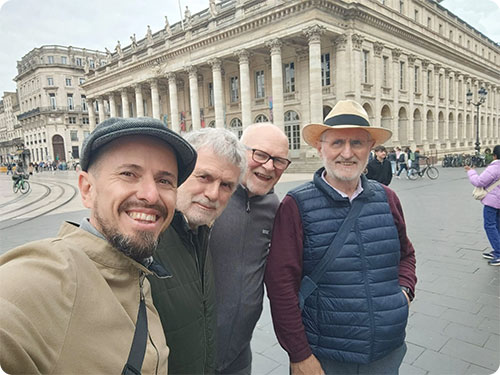
The Grand Théâtre
The Grand Théâtre was completed in 1780 under the direction of Victor Louis. It is a monument to the movement’s ideals, blending functionality with aesthetic purity.
Its facade, adorned with a portico of 12 Corinthian columns, evokes the temples of antiquity, while its harmonious proportions reflect the Enlightenment’s obsession with mathematical precision.
The Place de la Bourse
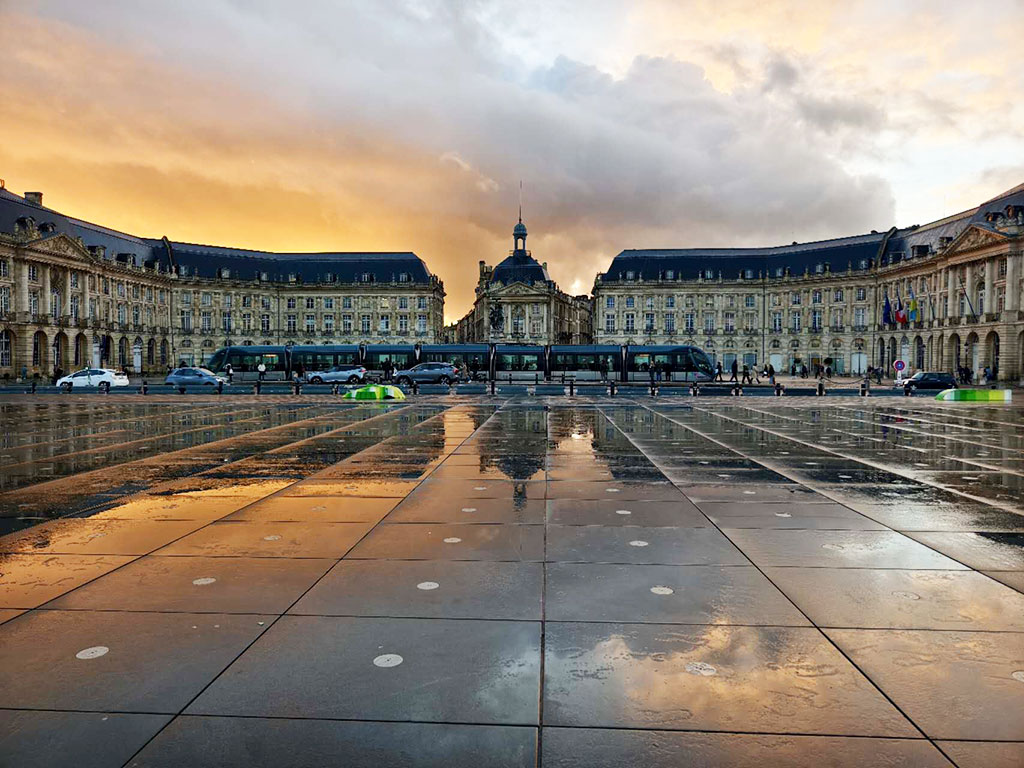
The Place de la Bourse was constructed between 1730 and 1755 under the supervision of royal architect Ange-Jacques Gabriel, who also designed the Place Vendôme in Paris.
Urban planning was at the center of the project which was part of a broader initiative led by Tourny who sought to open up Bordeaux’s cramped medieval core.
Tourny’s vision aligned with neoclassical principles: wide boulevards, uniform building heights, tree avenues.
A city shaped by the river
What makes Bordeaux so memorable is the way its architecture opens toward the Garonne. The city’s quays, squares, and façades form a continuous urban scene that feels both ordered and alive, with the river acting like a mirror for the buildings along its edge. This is especially visible at the Place de la Bourse, where the elegant 18th-century façades and the famous water mirror create one of the city’s most iconic views.
For visitors, this is one of Bordeaux’s greatest pleasures: you do not simply visit monuments, you walk through a city that was designed to be seen as a whole.
More than a postcard
Bordeaux’s neoclassical heritage is not limited to the grandest landmarks. It continues in the broad streets, balanced façades, and consistent building heights that give the historic center its calm and unified character. The Grand Théâtre is another perfect example, with its Corinthian colonnade and monumental symmetry expressing the ideals of the Enlightenment in stone.
This architectural continuity is part of what makes Bordeaux different from many historic cities. Instead of a patchwork of unrelated styles, it offers a rare sense of coherence, where public spaces, civic buildings, and riverfront views all belong to the same urban story.
Why it still matters
Bordeaux’s UNESCO status is not just a label for the past; it reflects a city that still lives inside its heritage. The historic center remains inhabited, active, and constantly evolving, while preserving the urban identity that made it exceptional in the first place. That balance between conservation and modern life is one reason Bordeaux feels so elegant without feeling frozen in time.
In the end, Bordeaux is more than a beautiful city. It is a lesson in urban design, a showcase of Enlightenment ambition, and a place where architecture, history, and daily life continue to meet with remarkable harmony.